

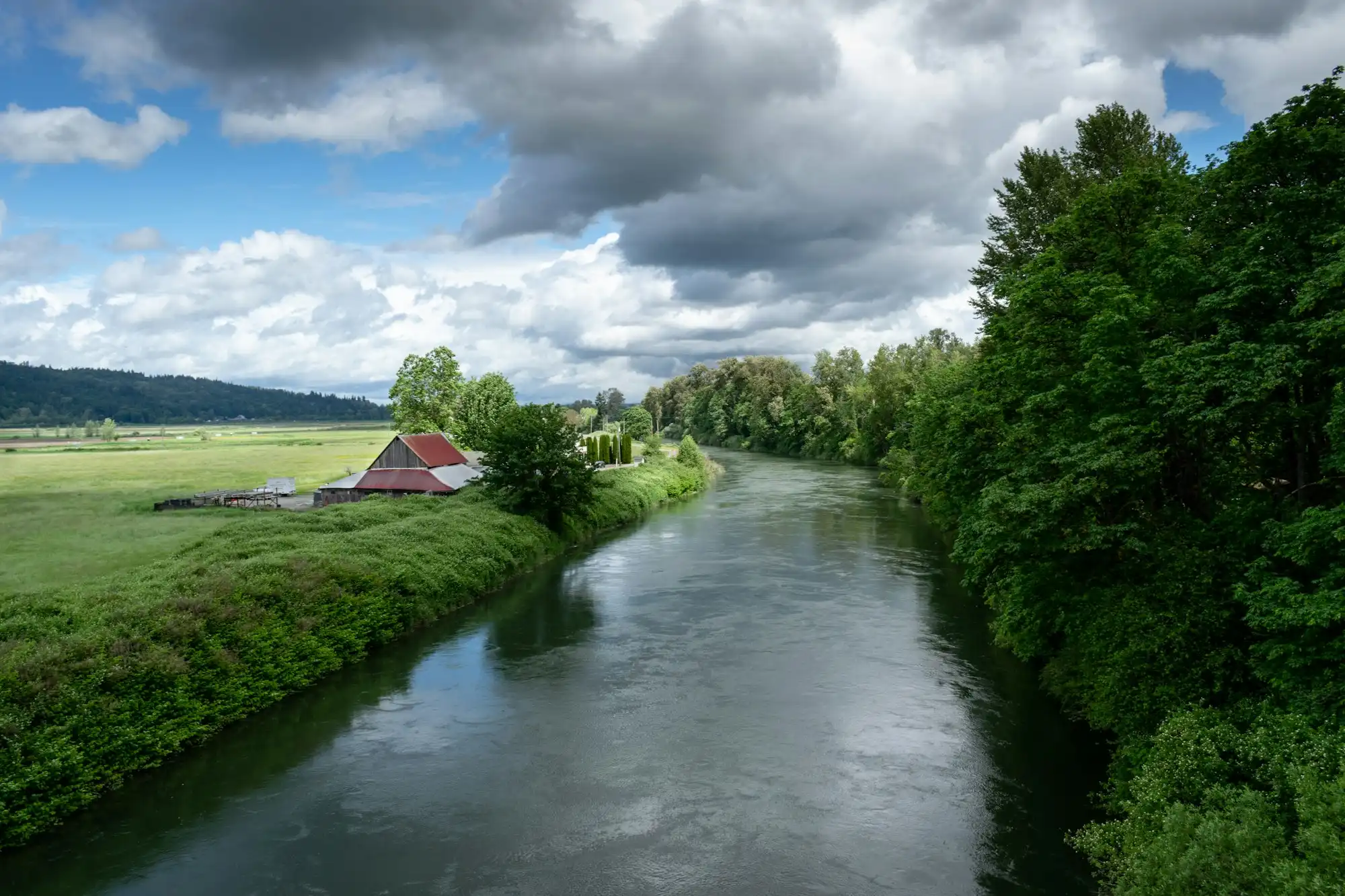
Most vacant land in the Snoqualmie Valley can’t be judged from the listing. Whether you can build on it comes down to zoning, water, septic, critical areas and access, and each one has its own agency and its own answer.
Our team works land and development deals across the Eastside and the Snoqualmie Valley. This is what we check before a client writes an offer, and what we confirm during the feasibility period after.
Start with jurisdiction and zoning
Zoning sets how many homes a parcel can hold, and it is the fastest thing to check. First find out who regulates the parcel. Duvall, Carnation, Snoqualmie and North Bend each run their own zoning and permits. Everything outside city limits falls under unincorporated King County.
In the unincorporated valley, most land carries one of these designations from King County’s zoning summary:
- RA-5 and RA-2.5: Rural Area, one home per 5 acres
- RA-10: Rural Area, one home per 10 acres
- A-10 and A-35: Agricultural, one home per 10 or 35 acres
- F: Forest
A 20-acre parcel zoned RA-10 is two homesites at most, before septic, water and critical areas take their share. Check the parcel for development condition codes too. A parcel-specific condition or an overlay can narrow what the base zoning allows.
Then confirm the parcel is a legal lot. King County requires legal lot status before it will treat a building application as complete, and the burden of proof sits with the applicant. This tends to come up with older parcels that were split off by deed and never went through a recorded plat.
Find out where the water comes from
A homesite needs a legal source of drinking water, and you will have to show one to get a building permit. There are two usual routes.
Connecting to an existing water system is usually the fastest and easiest route when the parcel sits inside a system’s service area. Around Duvall and Carnation, King County lists the City of Duvall, the City of Carnation, Water District 119, Ames Lake Water Association and Fall City Water District among the systems serving the valley. Which one covers a parcel depends on where it sits. Ask the district or association for a water availability letter, and ask what the connection costs.
The other route is a private well. The Snoqualmie River drains to the Snohomish, which puts the valley in the Snohomish watershed, known as WRIA 7. Under state rules, a new home on a well drilled on or after January 19, 2018 gets:
- 950 gallons per day as an annual average
- no more than 5,000 gallons on any single day
- up to half an acre of lawn and garden, counted inside the 950
- as little as 350 gallons per day, indoor use only, during a declared drought
Those limits come from the Department of Ecology’s WRIA 7 water availability sheet. They cover a household. They matter if you are planning livestock, a large garden or a second home on the same well.
A well is also a bet. Nobody can promise depth, flow or quality until it is drilled, so the well logs from neighboring parcels are worth pulling before you commit.
Septic: have a designer look before you buy
Outside the cities there is no sewer, so the soil decides whether you can build. Public Health – Seattle & King County strongly suggests having a septic designer inspect a vacant site for feasibility before you buy it.
What to know going in:
- A licensed designer or professional engineer has to prepare and submit the design.
- The designer digs test holes and reads the soil. Shallow soil, a high water table or steep ground can push you to a costlier system or rule out a location.
- An approved design is not a permit to install. The installation permit comes later, alongside the building permit.
- Some sites need a winter water table review, so the season you buy in can change how long feasibility takes.
- The drainfield and its reserve area take up room and need separation from wells and water. That shapes where the house can go.
The septic layout also has to work around critical areas, which is the next check.
Critical areas and the floodplain
Wetlands, streams, steep slopes and flood hazard areas can take a large share of a parcel out of play, and their buffers take more. This check can change what a parcel is worth more than anything else on the list.
King County adopted an updated Critical Areas Ordinance in December 2025. It took effect February 18, 2026 for land outside shoreline jurisdiction, and it expands buffers around certain critical areas. Buffer widths in an older study or listing may be out of date unless the parcel has a designation that is still in effect.
Three things to do:
- Look at King County iMap for mapped wetlands, streams, landslide hazards and flood layers. Treat it as a first pass. Exact boundaries come from a site-specific report by a qualified professional.
- Consider a Critical Areas Designation. The county sets the limits of critical areas and buffers on the site, and the result holds for five years. The county says it decides within 120 days of a complete application, and it requires the designation before you apply to Public Health for septic or well approval on a residential project.
- On the valley floor, check the flood maps. All development in a mapped floodplain needs a permit, and new homes have to sit three feet above the 100-year flood elevation. The floodway, where the river needs room to overflow, is far more restrictive. King County’s River and Floodplain Management Section, at 206-477-4812, will confirm where a parcel sits.
Access, power and what the title report shows
A parcel you can’t legally reach or power is not a homesite yet. Check these during feasibility:
- Legal access: a recorded easement or frontage on a public road, not a driveway everyone has always used. Ask who maintains a shared private road and whether there is a written agreement.
- Driveway and fire access: long or steep driveways can trigger road and fire standards that add cost.
- Power and internet: ask the utility how far the nearest connection is and what it costs to extend. On rural parcels this can be a major line item.
- Title: read the easements, covenants and restrictions of record. Look for utility corridors, shared wells, conservation easements, and timber or open space tax designations, which can mean back taxes if the use changes.
- Survey: if the corners are not marked, a boundary survey tells you what you are buying and where the buffers and setbacks fall.
A recent example
Buyers asked us to look at a rural parcel north of the valley that was marketed with a three-lot concept. The county had never reviewed that concept, so we told them to value the land as one homesite with upside. The low tax bill came from an open space agricultural classification, which means back taxes if the use changes. A wetland mapped across the middle, untested soils and no confirmed water source were the open questions, which is normal for raw land.
Write the offer around feasibility
The offer should give you time to answer these questions before you are committed. On Northwest MLS forms that is the feasibility contingency, Form 35F, attached to the vacant land agreement.
How we approach it:
- Size the feasibility period to the slowest item. We usually ask for 45 to 60 days on raw land, and 90 to 120 when the parcel needs a Critical Areas Designation or a winter water table review.
- Get the cheap answers first. Zoning, legal lot status, flood maps and title cost little and can end the deal early.
- Spend on the expensive answers last. Soil work, a wetland delineation and a survey come after the parcel has passed the free checks.
- Ask the seller for what already exists: septic design and as-builts, soil logs, survey, wetland or geotech reports, well logs, county letters or old permits, and any road maintenance agreement. Often the seller has done no due diligence at all. We take whatever exists and plan on doing the rest ourselves.
The people who answer these questions are a septic designer, a wetland biologist or geotechnical engineer where needed, a surveyor, the title officer and county staff. We are brokers, not attorneys or engineers. Our job is knowing which questions to ask, in what order, and who to call.
Costs depend on the parcel, and county fees change every year. Ask us for current quotes from the designers and surveyors we use.
Frequently asked questions
Can I build a house on any vacant land in the Snoqualmie Valley?
No. The parcel has to be a legal lot with zoning that allows a home, a legal water source, soil that supports a septic system, and a building site outside critical areas, their buffers and the restricted parts of the floodplain.
How much water can a new well provide for a home near Duvall or Carnation?
State rules for the Snohomish watershed limit a new home on a well drilled on or after January 19, 2018 to an annual average of 950 gallons per day. Up to half an acre of lawn and garden is allowed and counts inside that amount.
Should I get a septic design before buying land in King County?
Have a licensed septic designer inspect the site before you buy, which is what Public Health recommends. A full approved design usually comes during the feasibility period, after the offer is accepted.
What is a feasibility contingency on a land purchase in Washington?
It is a period in the purchase agreement for the buyer to investigate the land and decide whether to go forward. On Northwest MLS forms it is Form 35F, and its length is negotiated in the offer.
Social Cookies
Social Cookies are used to enable you to share pages and content you find interesting throughout the website through third-party social networking or other websites (including, potentially for advertising purposes related to social networking).